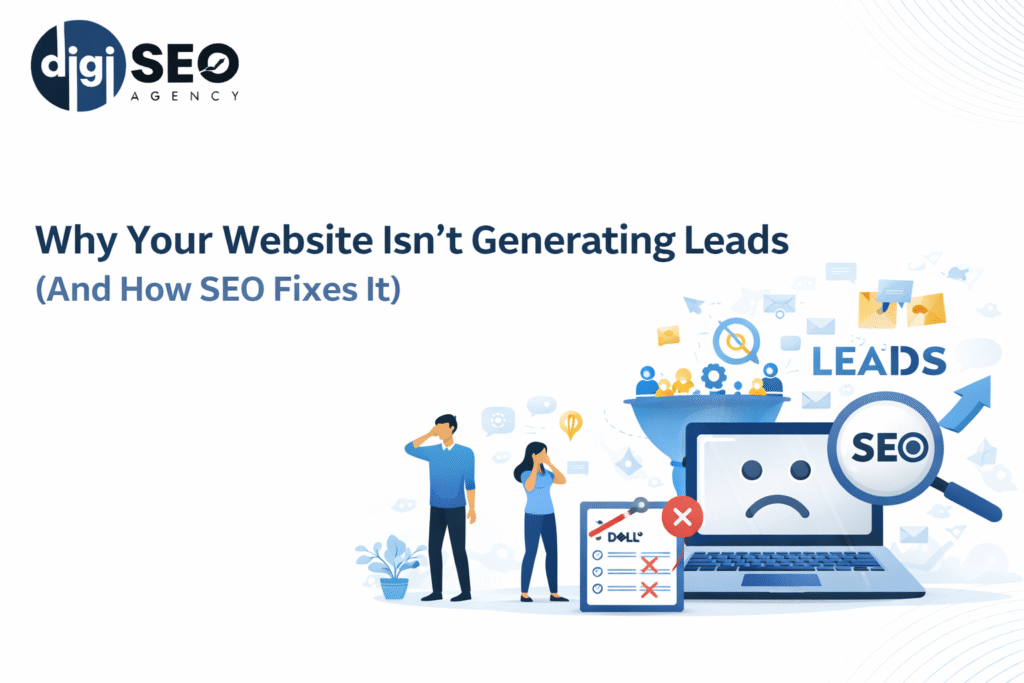
You’ve invested in a website. You’re getting traffic.
But your inbox? Quiet.
If this sounds familiar, you’re not alone. Many business owners and marketing teams face the same frustrating problem: website traffic but no leads. And the question keeps coming up—
Why is my website not generating leads, even though people are visiting it?
The short answer: traffic alone doesn’t convert. Strategy does.
In this blog, we’ll break down why your website isn’t generating leads, the most common SEO mistakes killing leads, and how a focused SEO strategy can turn passive visitors into real business inquiries.
Common Reasons Websites Fail to Convert
Before blaming SEO, design, or ads, it’s important to understand one truth:
A website doesn’t generate leads by existing.
It generates leads by guiding users to take action.
Here are the most common conversion blockers we see in real projects.
You’re attracting the wrong audience
If visitors don’t match your ideal customer profile, they won’t convert—no matter how good your website looks.
Example:
A B2B service company ranking for broad “informational” keywords gets traffic from students and job seekers instead of decision-makers.
Result: High traffic, zero leads.
Your message isn’t clear enough
When users land on your site, they should immediately know:
- What you offer
- Who it’s for
- Why they should trust you
If they have to “figure it out,” they leave.
Weak or hidden calls-to-action
Many websites rely on a single Contact Us button in the header and expect leads to magically appear.
High-converting sites guide users with:
- Contextual CTAs
- Clear next steps
- Trust signals near forms
No trust-building elements
Even interested visitors hesitate if they don’t see:
- Reviews or testimonials
- Case studies
- Clear contact details
- Professional design
No trust = no leads.
SEO Mistakes That Are Killing Your Leads
SEO isn’t just about ranking. Done wrong, it can actively block conversions. Let’s look at the biggest issues.
Wrong Keywords
Ranking for keywords that don’t match buying intent is one of the top reasons a website is not converting visitors.
Bad example:
- “What is SEO?”
- “SEO meaning”
Better example:
- “SEO services for small businesses”
- “SEO for lead generation”
SEO should attract users who are ready to evaluate solutions—not just learn definitions.
Fix: Align keywords with problem-aware and solution-aware intent, not just volume.
Poor Page Structure
Even great content fails when it’s hard to read.
Common issues:
- Long text blocks
- No clear headings
- No visual hierarchy
- Important points buried deep
Users skim before they read. If your page doesn’t guide their eyes, they bounce.
Fix:
- Use proper H2 and H3 headings
- Keep paragraphs short
- Highlight benefits clearly
- Place CTAs after key sections
No Local Optimization
If you serve a specific city or region and ignore local SEO, you’re leaving high-intent leads on the table.
Signs of missing local optimization:
- No Google Business Profile optimization
- No location-based keywords
- No local landing pages
- No NAP consistency
Local users often convert faster because they’re actively looking for nearby solutions.
Fix: Use local SEO strategies to attract ready-to-call customers in your service area.
Slow Website Speed
Speed isn’t just a technical issue—it’s a conversion killer.
Real impact:
- A delay of even 1–2 seconds increases bounce rate
- Slow sites lose impatient, high-intent users
- Google rankings suffer as well
Fix:
- Optimize images
- Improve Core Web Vitals
- Use proper caching and hosting
SEO and performance go hand in hand.
How SEO Improves Website Conversion Rates
This is where SEO becomes more than rankings.
A well-executed SEO strategy focuses on intent, experience, and trust—not just keywords.
Attracting the right users
SEO helps you rank for keywords used by people actively looking for solutions, not just information.
This alone increases lead quality.
Better landing page experience
SEO-driven content is structured, scannable, and focused on user needs—making it easier to convert visitors.
Aligning content with user intent
Instead of generic pages, SEO encourages:
- Problem-focused messaging
- Clear value propositions
- Logical content flow
This builds confidence and reduces hesitation.
Supporting the full buyer journey
SEO content educates, reassures, and nudges users forward—especially when supported by internal links to:
- Service pages
- Case studies
- Contact or audit pages
This is how you improve conversion rate with SEO, not by forcing sales—but by removing friction.
Realistic SEO Results Timeline (Honest Expectations)
Let’s be clear—SEO is not instant.
Here’s what most businesses can realistically expect:
Month 1–2
- Technical fixes
- Keyword mapping
- Content optimization
- Website performance improvements
Early signs: better engagement, lower bounce rate
Month 3–4
- Ranking improvements for mid-intent keywords
- Increased qualified traffic
- First noticeable lift in inquiries
Month 5–6+
- Stable rankings
- Higher-quality leads
- Stronger ROI from organic traffic
SEO compounds over time. The longer it runs, the stronger and more predictable your lead flow becomes.
Is Your Website Losing Potential Leads?
If your website is getting visitors but not inquiries, something is broken—and it’s usually fixable.
A proper SEO audit can uncover:
- Keyword intent mismatches
- Conversion-blocking SEO mistakes
- Technical and speed issues
- Missed local SEO opportunities
Instead of guessing, get clarity.
Request a SEO Audit
No pressure. No sales tricks. Just honest insights into why your website isn’t converting—and what to fix first.
Conclusion: Traffic Is Easy. Leads Require Strategy
If you’ve been wondering why your website isn’t generating leads, the answer usually isn’t one single issue—it’s a mix of SEO intent, page structure, user experience, and trust signals.
The good news?
These problems are completely solvable.
With the right SEO for lead generation, your website can stop acting like a static online brochure and start working as a real business asset—bringing in consistent, qualified leads month after month.
At DIGI SEO Agency, we help businesses identify exactly what’s holding their website back and fix it with data-driven, conversion-focused SEO strategies.
If you’re ready to turn traffic into real results, the first step is understanding what’s broken—and how to fix it the right way.